
Now then, I’m not always right (well, so people tell me, but it’s yet to be proven) but whomsoever answers imperial to the “Imperial v Metric” question is clearly a glass of wine short of a piss up.
I mean, I can kind of understand the argument “it’s what I’m used to”, but even that be the talk of a crazy person – just get used to something far more sensible and easy to understand – yup, it ain’t rocket science (actually, I’m pretty sure rocket science will be all metric these days, even in NASA ( just checked and it is, but only since 2007 – crazy folk)).
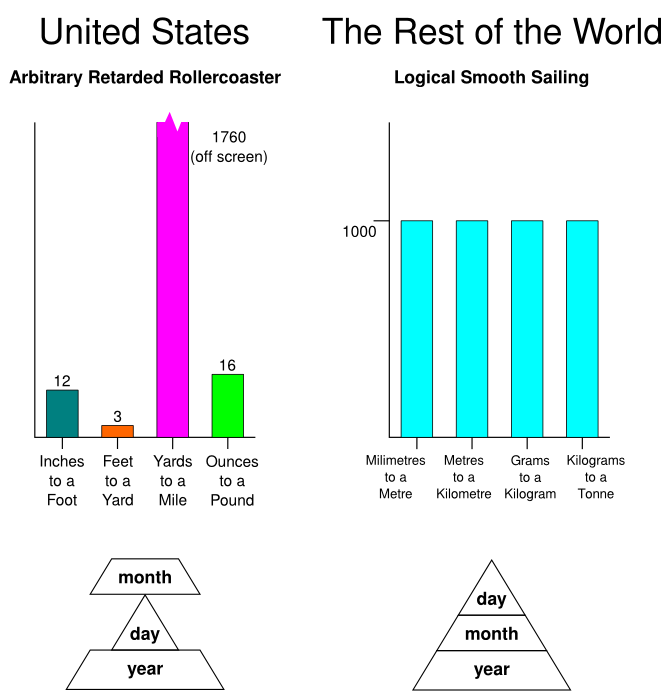
That just about sums it up…
So why do those great nations of Burma, Liberia and the United States, as well as many of my British friends (you know who you are) still have a hangover, not from good things like beer, but from the bad thing of imperial measurements? It’s because they *think* they know imperial measurements better than metric – but they don’t. Do you think you know imperial better than metric…? In that case, let’s prove a point…
We’ll start with mass because everyone knows what an ounce is and how to chop it up into eighths, right? So it should be an easy one, so…
How many grains in a drachm? 60
How many drachms in an ounce? 16
How many ounces in a pound? 16
How many pounds in a stone? 14
How many stone in a quarter? 2
How many quarters in a hundredweight? Yup, 4 – that one makes sense!
How many hundredweight in a ton? 100? Nope, 20.
So one of those was easy to guess and maybe you knew another one or two but weren’t really sure. If you’re interested in trying to figure out relationships where none really exist, you can check it out here, and this website explains the origins of the insanity.
OK, let’s do the same with metric weights…
How many milligrams in a centigram? 10
How many centigrams in a decigram? 10
How many decigrams in a gram? 10
How many grams in a dekagram? Er…10?
How many dekagrams in a hectogram? Yup, 10
How many hectograms in a kilogram? I’m reckoning 10
Hmmm…seems all too easy, dunnit? Let’s take the ones you’re familiar with – a milligram is a thousandth of a gram because milli means thousandths. Likewise, kilogram is a thousand grams because kilo means thousand. Obviously this applies to most other units of measurement – try it with a litre or a metre!
OK, so you’re not used to the measurement itself, you don’t know what a kilogram represents in the real world, but you could roughly weigh an ounce into your hand (through years of practice no doubt), so let’s prove a couple of other points…

Rods and hogsheads – only someone with 3 bonks of understanding would know
Let’s make up a unit of measurement that neither you nor I understand – it is a measurement of one’s understanding of the Imperial system and let’s call the base metric unit “imps”. In the metric system we know immediately that a thousand milli-imps is equivalent to one imp. We also know that there are a thousand imps in one kiloimp. I’d imagine my understanding of the Imperial system is right around the picoimp mark. So what is the Imperial system’s interpretation of the imp? well it wouldn’t be called an imp, let’s call it a bonk. You probably get knobs and orgies as well, but how many knobs in a bonk? And how many bonks in an orgy? Who knows? My guess is anywhere between 1/356 and 1260.
OK, so there’s the abstraction to show you don’t need to even know what you are measuring but you can still use and understand metric, “but…!” I hear you cry, how does that relate to the real world – I can still measure a rough ounce but not a rough kilogram. But you can…and all you need is water. I’ll let John Bazell explain this because he does it so eloquently in his book “Wild Thing”:
In metric, one millimeter of water occupies one cubic centimeter, weighs one gram and requires one calorie of energy to heat up by one degree centigrade – which is one percent of the difference between its freezing point and its boiling point. An amount of hydrogen weighing the same amount has exactly one mole of atoms in it.
Whereas in America the answer to “how much energy does it take to boil a room-temperature gallon of water?” is “Go fuck yourself” because you can’t directly relate any of those quantities.
Now, admittedly he is talking about amounts that you might not use so often in every day life, so let’s use what we’ve learnt about the metric system to convert this into more everyday amounts thusly: 1 litre of water weighs 1 kilogram and occupies 1 cubic decimetre which is a cube with sides of 10 cm each. Wow – that was easy. So, take a 1 litre bottle of water…you know what that is, right? Imagine it as a cube…got it? From that you are accurately deducing metric weights (grams), volumes (litres and cubic metres), lengths (metres), areas (square metres), densitites (kg/l), and this all has implications for energy, temperature etc as Mr Bazell showed us above. So it seems you know an awful lot of real world metric measurements and you got them all from a bottle of water – good work.
The imperial equivalent…? Well, a pint of water weighs 1.25lb and is “approximately” 34.677429099 cubic inches which is a cube with sides of about 3.260986 inches each. Oh, unless it is a US pint in which case it weighs 1.041lb and is exactly 28.875 cubic inches. Nuff said.
Temperature – now there’s a funny one, huh? Fairly abstract in a way, and not such a big imperial/metric argument because centigrade is fairly arbitrarily attributed to the metric system. Metric has two starting points of temperature – their units are the same, a kelvin being equal to a centigrade, but their starting points are different – zero degrees kelvin being absolute zero (nothing in the universe is colder (yet)) and zero degrees centigrade being the freezing temperature of water at sea level. Seeing as we’re talking about cooking (yes we are), we’ll stick to centigrade as the metric measurement, but first let’s look at the imperial – fahrenheit…what a fucking mess that is. Historically it made sense to one person – Mr Fahrenheit, but to the rest of us there really isn’t much point in it. I was once told by an imperialphile that fahrenheit makes perfect sense because 0ºF is the temperature at which a human will die from cold exposure. Bull-ahem-shit. I hope I don’t even have to go into why that is bollox, not least having to watch people keel over and die just to know the temperature…although that’s one way to relate imperial measures to real world situations I suppose.
The real reason that Mr Fahrenheit has 0ºF at that point is because that is the coldest he could get his lab to be. Hmmm…so his absolute zero basically depended on where in Germany his lab was and what time of year he was doing it.
But let’s take a couple of points of reference that we can really relate to in our every day lives – the point at which water freezes: 32ºF; the point at which it boils: 212ºF. That makes 1ºF equal to 1/180 of the interval between freezing and boiling water – great…thanks! Centigrade however has 100 beautifully neat steps between the freezing and boiling point of water and by definition raises by one of those degrees every time you put a certain amount of energy (a calorie) into a certain amount of water as Mr Bazell told us just not so long ago…see the beauty of a litre of water?
Anyway, the only question left is why time isn’t metric? I guess it’s only a matter of time before it is.
OK – rant over – as you were people, nothing to see here.


I think you have been a bit harsh on Mr Fahrenheit, he was doing his best. He got brine as cold as possible and called it zero. Then used blood temperature as 100 degrees, so not just an arbitary 212 deg for boiling water. He was a pioneer in the field and consequently looks very naive in today’s world.
By the way some body or organisation did try to decimalise time, making a 10 hour day of 100 minutes each, or something like it, but it never caught on. Don’t forget that 10 isn’t necessarily the best units to use, 16 or 12 could be much better bases being more easily divisible.
LikeLike
Don’t get me wrong, the last thing I want to do is mock Mr Fahrenheit because he is an extremely worthy pioneer in trying to make sense of the temperature scale, and does a very good job indeed, given his time in history and the tools and conditions available to him – without him I dare say we wouldn’t have centigrade. I do, however, mock modern day folk who still use that scale given the tools available to them. it’s like trying to rub two sticks together when you have a lighter.
LikeLike
Hmmmnmmm disagreed.
There is a time and place for the imperial system, and likewise one must suffer from the French metric on occasion. It’s a question of scale.
IMHO very small things are better measured, or having their measurement expressed, in metric terms. From the quantum to pico and nano, all the way up to milli, I’m fine with the metric. These things are clearly too small to worry about in any case. Similarly, the super massive, galactic and infinitely huge are better measured in metric terms as that’s what makes scientists happy. Especially French ones.
When one gets to human-sized measurements, imperial makes absolute sense. An inch is approx one’s thumb from the last joint to tip, a foot is an average foot size, a yard is a pace – averagely half a person’s height – men are average 6 feet, a newborn baby is averagely 7lbs, a good trout weights 4lbs plus, all easy to gauge, imagine, visualise and remember.
These imperial rule-of-thumb measurements are real-world, just-about, that’ll-do, thereabouts measures for real life. The miniscule and massively universal are impossible to measure by actual everyday people, and why would we? Let the machines employed by scientists and engineers who care about such things, measure them, with laser accuracy if they must.
LikeLike
I’m with you Phil.T.Tipp….to an extent.
For example – a yard is roughly a pace, however I happen to know a young fellow (perhaps you know him too?) whose pace is half that of mine. 50% is quite a large margin of error.
I do however appreciate all your points on why the imperial system works for you. But the one point I agree on more than any other that you have made so succinctly and perhaps not vehemently enough, is your point on why NOT to use the metric system…and that is because it is largely made up of “french”. Pah – sacre bleu!
LikeLike